Inside Skupie

Five places for the questions that come up every school year — plus a short guide to how it all works.

School Readiness

Know what your state asks for, before the first day.

Every state requires certain vaccines for school, and the rules differ from state to state. Pick your state and your child’s grade, and School Readiness shows your state’s school-entry schedule in plain words, with a link to the official source.

  • Required vaccines for your child’s grade
  • Health exams and screenings, such as vision and hearing, where your state requires them
  • Which kinds of exemption your state allows, and where to find the current forms and rules
  • All 50 states and Washington, D.C.
  • Each required vaccine links to its card in Vaccines

Your school or district can have its own rules on top of the state’s. Your school nurse knows them. Whether to use an exemption is your decision.

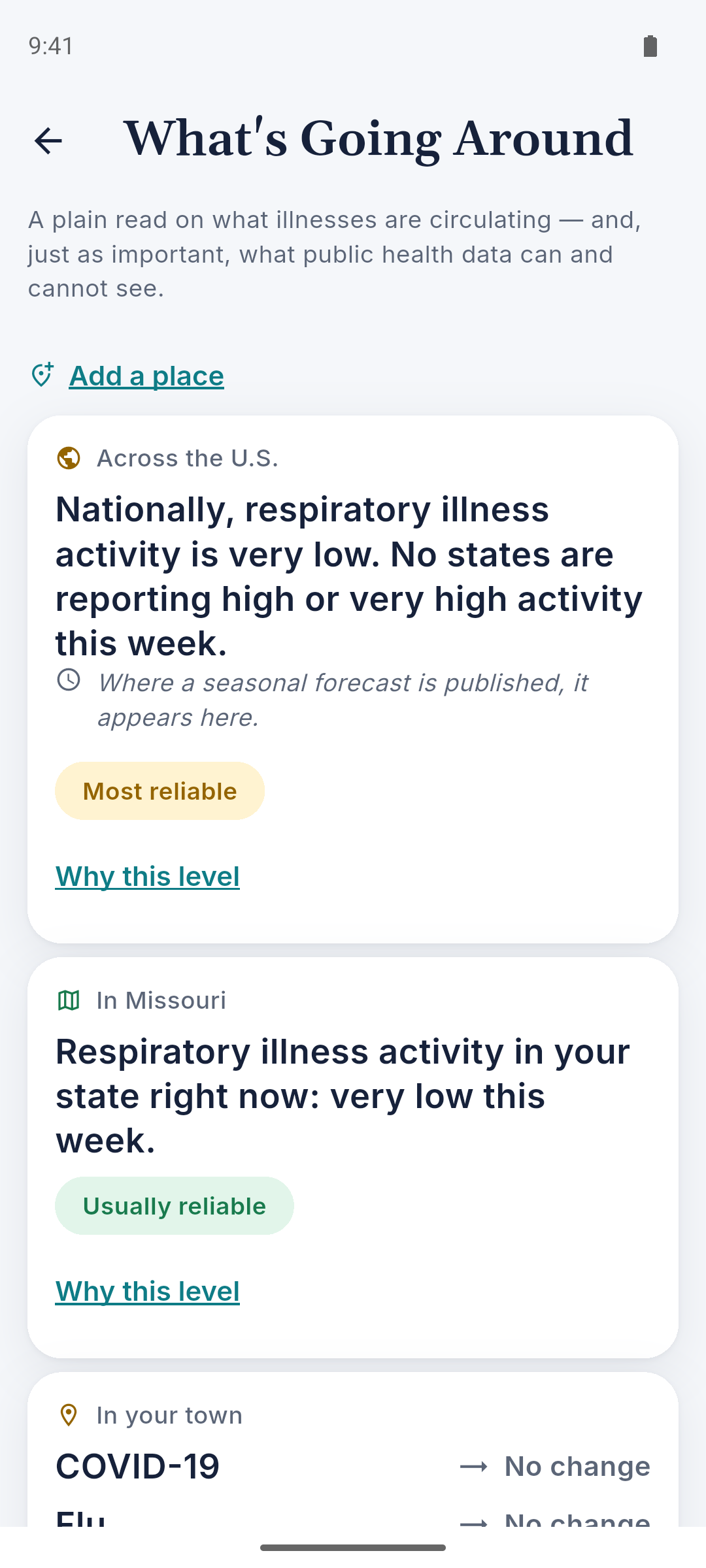
The School Readiness screen in Skupie, showing Missouri’s routine school-entry schedule for the 2026-2027 school year.

Fact Sheets

Plain answers about the illnesses kids catch.

Fact Sheets cover 41 infectious diseases that matter most to K–12 families, from flu and strep throat to measles and whooping cough. Each one starts with three quick answers — School, Near You and Vaccine — and then goes as deep as you want.

  • Essentials — what it is and the signs to watch for
  • Guidance — care at home, over-the-counter options to ask about, and when to keep your child home
  • Deep Dive — how it spreads and how long it lasts
  • Clear signs for when to call 911

Stay-home rules are set by your school and your local health department. Follow theirs.

Head Lice

Stay Home?
No, can attend
Near you
—
Vaccine
No vaccine

Essentials

Tiny scalp insects that are harmless, carry no disease, and are not a reason for a child to miss school.

Common symptoms

  • Itching of the scalp, especially behind the ears and at the back of the neck
  • A tickling feeling, or the sense of something moving in the hair
  • Itch may not appear for weeks after lice first arrive
  • Sores from scratching, which can occasionally become infected
  • Best confirmed by finding a live, moving louse - not by nits alone

Get care right away if you see

  • The scalp looks infected - spreading redness, warmth, swelling, or pus
  • The store-bought treatment has not worked, even when used correctly twice
  • The child is under 2, where treatment choices are limited
  • None of these are emergencies. Head lice are never a medical emergency.

When to Stay Home

May attend school

Returning to school

No exclusion is needed. CDC, AAP and the school nurses' association all say the same thing. A child with lice finishes the day, is treated that evening, and returns the next morning. All three call for an end to no-nit policies. Some schools still enforce no-nit rules. If yours does, you are caught between the guidance and the rule at the door.

Your school or district may set its own rule. Check with them before deciding.

Contagious period

While live lice are present. Once effective treatment kills the crawling lice, the risk of transmission drops sharply even if nits remain.

Guidance

Guidance is settled The medical consensus is settled and unusually unified: CDC, AAP, and NASN agree lice are not a health hazard and no-nit exclusion should end. What varies is whether an individual school has updated its policy.

How it spreads

Mainly by direct head-to-head contact - lice crawl, they cannot jump or fly, which is why they spread slowly in classrooms. Occasionally through shared combs, brushes, hats, or hair accessories, though CDC notes this route is uncommon. Lice do not survive long off a human head. CDC is explicit that head lice are not a sign of poor hygiene and anyone can get them.

Prevention steps

  • Avoid head-to-head contact, the main route - though this is hard to enforce in children
  • Discourage sharing combs, brushes, hats, and hair accessories
  • Machine-wash and hot-dry recently used bedding, clothing, and towels
  • Items that cannot be washed can be sealed in a bag for two weeks
  • Extensive house cleaning and insecticide sprays are not necessary

What to do if exposed

Check the child's head, looking for live moving lice rather than nits alone. If you find live lice, treat that evening with an FDA-approved product and plan the second treatment for 7 to 10 days later. There is no need to keep the child home - CDC's position is they finish the school day, are treated, and return the next morning. Check other household members' heads too.

Caring for someone sick

Treat with an FDA-approved product, following the instructions exactly. A second treatment about 7 to 10 days later is usually needed to kill newly hatched lice. Skipping it is the commonest reason treatment seems to fail. Comb wet conditioned hair with a fine-toothed nit comb, to remove lice and nits and to check whether it worked. Do not repeat the same product if it is clearly not working. Ask a provider instead.

When to see a provider

Call if the store-bought treatment has not worked after correct use, including the second round. Call if the scalp looks infected from scratching. Call if your child is under 2, where treatment choices are more limited. Call if you are unsure whether you are seeing live lice or only old nits. None of these is urgent. Head lice are never a medical emergency.

Deep Dive

What causes it

Head lice are tiny wingless insects that live on the human scalp and feed on blood. They cannot jump or fly - they crawl, which is why direct head-to-head contact is the main route and classroom spread is slow. They carry no disease. CDC states plainly that head lice are not a health hazard and not a sign of poor hygiene. Nits are the eggs, glued to hair shafts; many are empty casings or too far from the scalp to be viable.

Incubation period

The itch is an allergic reaction. It may not appear for 4 to 6 weeks after lice first arrive, above all on a first infestation.

Symptom progression

Itching of the scalp, especially behind the ears and at the nape of the neck, is the main symptom, sometimes with a tickling sensation of movement in the hair. The itch may take weeks to develop. Scratching can break the skin and occasionally lead to a secondary infection. There are no systemic symptoms - head lice do not cause fever or illness.

Possible complications

Head lice cause almost no physical harm, beyond the odd skin infection from scratching. AAP's clinical report identifies the real harm as psychological. It names high anxiety among caregivers, real stigma, and children shut out of school and social life. It describes that as stressful for the affected child. This is why the advised approach is calm and matter-of-fact.

Treatment information

Several FDA-approved treatments exist. They include permethrin, pyrethrin-based products and prescription options, chosen by age, cost and past treatment. A second application about 7 to 10 days after the first is usually needed. It kills lice that hatch from eggs the first one did not affect, and skipping it is the commonest reason treatment seems to fail. Combing wet conditioned hair with a fine-tooth comb helps remove lice and nits. It also lets a parent check whether the treatment worked. Some older products meet resistance, so a product that clearly is not working should send you to a provider rather than be used again.

Special populations

Pregnancy

Treatment choices in pregnancy should be discussed with a provider, who will select an appropriate product. Head lice pose no danger in pregnancy.

Pediatric

Head lice are above all a childhood issue, spread by the head-to-head contact common in play. Children under 2 need provider guidance on treatment. The most important message for children is that lice are common and harmless. They are no reason for shame or missed school.

Elderly

Head lice are uncommon in adults, who rarely have the head-to-head contact that spreads them. Treatment is the same.

Immunocompromised

Head lice carry no disease and pose no special risk to people with weakened immune systems. Treatment is unchanged.

CDC states head lice are not a sign of poor hygiene and anyone can get them, and AAP identifies stigma as the main harm they cause - children ostracized and stressed over an insect that carries no disease. A lice infestation says nothing about a family. This card is deliberately calm because calm is the clinically recommended response.

Sources

Hand, Foot & Mouth Disease

Stay Home?
Yes, stay home
Near you
—
Vaccine
No vaccine

Essentials

A mild but very contagious viral illness, with mouth sores and a rash on the hands and feet. The real risk is dehydration from a sore mouth, not the rash.

Common symptoms

  • Fever and sore throat, often first
  • Painful sores in or around the mouth
  • A blister-like rash on the palms, soles, and sometimes buttocks or legs
  • Loss of appetite, and irritability in babies and toddlers
  • Symptoms usually appear 3 to 5 days after exposure

Get care right away if you see

  • Not drinking, with signs of dehydration - no wet diaper for hours, no tears, dry mouth
  • Fever lasting longer than three days
  • A stiff neck, or a child very hard to wake or seeming very sick
  • Any HFMD in a newborn

When to Stay Home

Should stay home

Returning to school

A child returns once the fever is gone, the mouth sores have healed, and they are well enough to take part. Not once the virus is gone: that can take weeks to months and would mean endless absence. Health-department guidance states that testing is not required and a doctor's note should not be demanded. The rash alone, after fever and sores have gone, is not a reason to stay home.

Your school or district may set its own rule. Check with them before deciding.

Contagious period

Most catching in the first week of illness. But the virus is shed from the airway for 1 to 3 weeks, and in stool for weeks to months after the infection starts.

Guidance

Guidance is settled Well established. The key point parents miss is that no realistic exclusion makes a child truly non-infectious, because shedding lasts weeks to months - so guidance keys on fever and mouth sores, not virus clearance.

How it spreads

By droplets from coughing, sneezing and talking. By contact with fluid from the blisters. And by the fecal-oral route, which is the most common way it spreads. Also by dirty surfaces and objects, which is why it moves quickly through childcare. It is most catching in the first week. But children shed the virus from the airway for one to three weeks, and in stool for weeks to months after symptoms end. Some infected children never have symptoms at all.

Prevention steps

  • Wash hands with soap and water. Do it after the toilet, after diaper changes and before meals
  • Disinfect shared surfaces and toys, particularly in childcare
  • Avoid sharing cups and utensils with someone who has it
  • Accept that shedding continues for weeks - full prevention is not possible
  • There is no vaccine

What to do if exposed

There is no preventive treatment. Watch for fever, mouth sores and the hand-and-foot rash over the next 3 to 5 days. Shedding lasts weeks to months and many children have no symptoms, so exposure is often impossible to avoid. Hand washing lowers spread but does not stop it. If symptoms appear, the priority is keeping the child drinking.

Caring for someone sick

No medicine treats HFMD, and antibiotics do nothing against a virus. Care is comfort and, above all, fluids, because the painful mouth sores are what tip a child into dehydration. Offer fluids often, in small amounts. Cold drinks, ice pops and soft cool foods are easier on a sore mouth than warm or sour ones. For fever or pain, ask a pharmacist what suits your child's age, and never give aspirin. The rash needs nothing.

When to see a provider

The main reason to seek care is dehydration. That is a child who will not drink because of a painful mouth, with no wet diaper for hours, no tears, or unusual sleepiness. Also call for a fever lasting more than three days. Call for a stiff neck, a child who seems very sick or is hard to wake, or symptoms getting worse after a few days. Call for any HFMD in a newborn.

Deep Dive

What causes it

HFMD is a common, mild viral illness. It spreads very easily. It is usually caused by coxsackievirus A16, an enterovirus. Enterovirus A71 and coxsackievirus A6 also cause it. It is not the same as foot-and-mouth disease. That is a different virus, and it affects only animals. Children cannot get it from farm animals. It is most common in children under 5, but it can happen at any age. Clusters in adults are unusual, but they happen.

Incubation period

Symptoms usually appear 3 to 5 days after exposure.

Symptom progression

Often begins with fever, sore throat and a general unwell feeling. Painful sores then develop in or around the mouth. They are often the most distressing part, and the reason some children stop eating and drinking. A rash of flat red spots or blisters follows on the palms and soles, and sometimes the buttocks, legs, or around the mouth. In children it is usually not itchy. Symptoms are worst in the first few days and settle over roughly a week. Now and then a nail comes off a few weeks after recovery.

Possible complications

HFMD is almost always mild and clears on its own, and serious problems are rare. The one practical hazard is dehydration. Painful mouth sores can make a child unwilling to drink, and in a small child fluid loss is the thing to watch. Now and then a fingernail or toenail comes off a few weeks after recovery. That is a CDC-documented finding and a harmless one, more often after coxsackievirus A6, and the nail grows back on its own. Very rarely, enterovirus A71 is linked to more serious illness of the nervous system.

Treatment information

There is no specific treatment and no vaccine, and antibiotics do nothing against a virus. Care is all comfort, and above all fluids, because the painful mouth is what causes dehydration. Cold and soft foods go down better than warm, salty, spicy or sour ones. For fever and pain, use a product suited to the child's age that a provider or pharmacist has advised. Aspirin is not given to children. The rash needs no treatment, and blisters should not be broken on purpose.

Special populations

Pregnancy

HFMD is usually mild in pregnancy. Talk over any concerns with a provider. That matters most around the time of birth, when infection in a newborn calls for more care.

Pediatric

This is above all a young-childhood illness, and it spreads fast in childcare and school. The main thing to watch is fluids. A child with painful mouth sores can slip into dehydration, and that is the reason HFMD sometimes needs medical care.

Elderly

Adults can get HFMD, usually mildly, though clusters are unusual. Care is the same - comfort and fluids.

Immunocompromised

People with weak immune defenses may have a longer or harder course. They should ask for advice if symptoms are unusually bad.

HFMD spreads readily among young children in ordinary settings and says nothing about a family's cleanliness - shedding continues for weeks to months and many carriers have no symptoms, so exposure is often unavoidable. A parent who could not stop it spreading did not fail; it is not fully containable. This card does not assign blame.

Sources
Vaccines

Understand each vaccine.

Vaccines explains what each vaccine protects against, how it’s given and at what ages. There is a card for every vaccine on the national schedule for children and teens, and every vaccine a state requires for school.

  • What it protects against, in plain words
  • The usual ages and number of doses
  • Where to ask: your child’s health care provider, your school nurse, or Vaccines.gov

Skupie does not tell you to get or skip any vaccine. That decision is yours to make with your child’s health care provider.

Measles vaccine

MMR

Required for school?
Not listed
Add your state and a child in Settings
When
Birth to 6 years
19 to 64 years
65 years and older
Protects against
Measles, Mumps, Rubella

Essentials

Routine schedule

Routine on the CDC schedule for: Birth to 6 years, 19 to 64 years, 65 years and older

MMR vaccine

Children need 2 doses of MMR vaccine, usually:

  • First dose at age 12 through 15 months
  • Second dose at age 4 through 6 years

Infants who will be traveling outside the United States when they are between 6 and 11 months of age should get a dose of MMR vaccine before travel.

These children should still get 2 additional doses at the recommended ages for long-lasting protection.

Older children, adolescents, and adults also need 1 or 2 doses of MMR vaccine if they are not already immune to measles, mumps, and rubella. Your health care provider can help you determine how many doses you need.

A third dose of MMR might be recommended for certain people in mumps outbreak situations.

MMR vaccine may be given at the same time as other vaccines. Children 12 months through 12 years of age might receive MMR vaccine together with varicella vaccine in a single shot, known as MMRV.

Your health care provider can give you more information.

Whether this vaccine is required for school is decided by your state, not by the CDC. See School Readiness for your state.

Talk to your doctor to decide what's right for your child. Your school nurse can tell you what your school needs and by when.

Where this comes from

What’s Going Around

Know what’s going around near you.

See outbreaks and health alerts for your state and county. Every alert comes from an official public health agency, and one outbreak shows up as one card — not a pile of repeats.

  • Local Outbreaks for the 41 diseases Skupie covers
  • Health Alerts when an agency issues one
  • Urgent alerts only when an agency declares one; a short weekly summary for everything else
  • You choose your alerts: weekly summary, urgent only, or off

Reporting is clearest for the whole country, usually good for your state, and often missing for your town. Skupie shows each level and tells you how reliable it is.

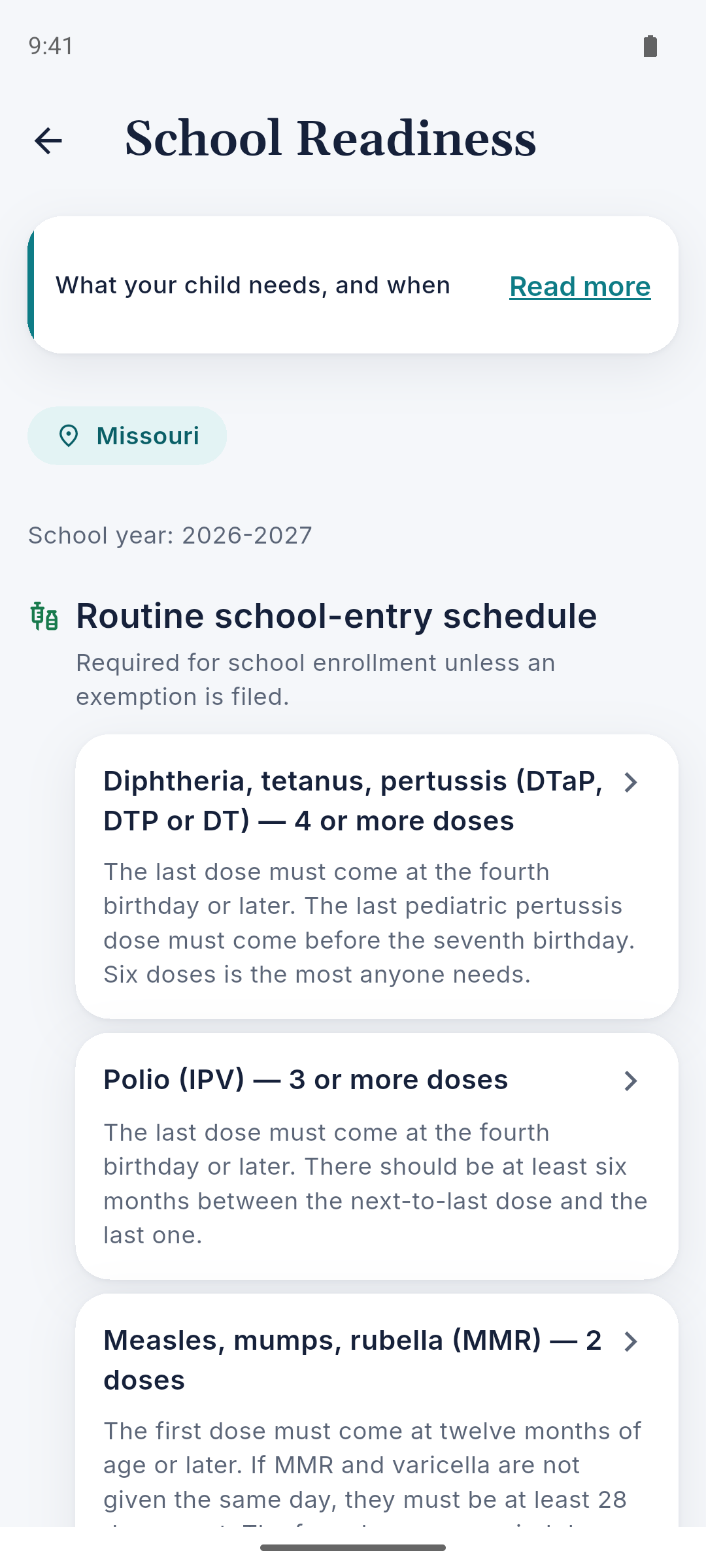
The What’s Going Around screen in Skupie, showing that respiratory illness activity is very low across the U.S. and in Missouri this week.

Ask a Question

Ask in your own words.

Ask about school requirements, vaccines and the illnesses in the app, in your own words. Ask a Question answers from the same public sources as the rest of Skupie and tells you where each answer came from.

  • Plain-language answer cards, each with its source
  • Answers you keep are saved in a library on your phone, not in our cloud
  • It does not know your child and does not diagnose. Ask about symptoms and it will tell you to call a provider — that is the right answer.

Ask a Question is not for emergencies. If your child is very sick or you are worried, call your health care provider. In an emergency, call 911.

Ask a Question

Answer

Example

Can my child go to school with head lice?

No exclusion is needed. CDC, AAP and the school nurses' association all say the same thing. A child with lice finishes the day, is treated that evening, and returns the next morning. All three call for an end to no-nit policies. Some schools still enforce no-nit rules. If yours does, you are caught between the guidance and the rule at the door.

Your school or district may set its own rule. Check with them before deciding.

From: Head Lice fact sheet

Open fact sheet

If this is an emergency, call 911 now — do not wait for or rely on this app.

How This Works

A short guide, built in.

How This Works walks you through getting ready for school, knowing what’s going around, and what to do if you think your child is sick. It also explains who makes the rules: states set school vaccine requirements, the CDC publishes recommendations, and the FDA approves vaccines for safety. And it makes one thing clear — you decide what is best for your child.

How This Works

This app puts in one place what your state requires for school, which exemptions it allows, what illnesses are going around, and what to do when your child is sick. It is built for your state and your child's grade. Everything comes from official public sources, in plain language.

We keep it current so you can decide what is best for your children and your family.

1. Getting ready for school

Every state requires certain vaccines for a child to attend school. The list, the exemptions allowed, and how the rules are made all differ by state, and they change over time.

School Readiness shows your state's routine school-entry schedule for your child's grade, in plain words. It also tells you which kinds of exemption your state allows. Every state allows medical exemptions. Most states also allow religious or personal-belief exemptions. We show you where to find the current forms and rules. Whether to use one is your decision.

Your school or district can have its own rules on top of the state's. Your school nurse is the person who knows them. We link you to the official source for the current answer.

Open School Readiness

Ready for the school year?

Join the waitlist